
Targets
The targets system is a part of Mega Report and Practitioner report that allow you to set targets for any cell in the report. Values are automatically synced between Mega Report and Practitioner Report.
These values do not need to actually be targets, they could be: Target, Budget, Forecast, Plan, Quota, KPI, Breakeven, Floor, Baseline, Best or Worst Case, Threshold, Capacity Limit, Compliance Requirement or any other comparison you want to make with numbers that are on the report.
If you are a super data nerd, check Rules of Targets below for more detail.
Creating & Editing Targets
Target Sets
The main component is a TargetSet. This represents a "grouping" of numbers. For example the CFO might have the 2026 Budget as a TargetSet that only they and the CEO can see. Then this data can be entered for as many rows as you want. Each TargetSet has the following properties:
- TargetSet name (try to choose something that explains what it is more than just 'targets')
- TargetSet view permissions (who can see these targets)
- TargetSet edit permissions (who can change target values)
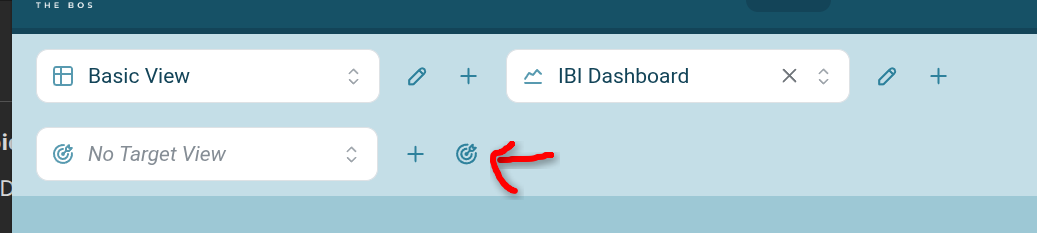
Click the target icon to start editing Target Sets. On a daily basis you will generally be comparing to targets but not editing them.
From here you can choose an existing Target Set to edit it, or create a new Target Set.
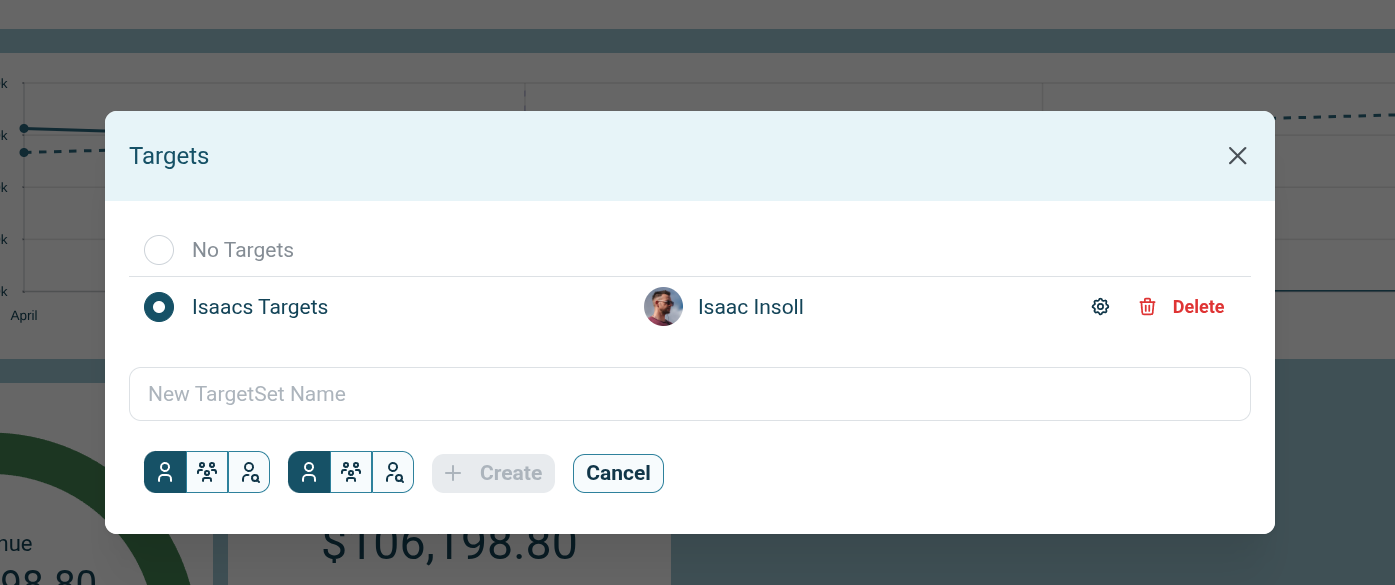
If you aren't doing something hugely complicated then it's possible you might just have one TargetSet for the whole business.
Target Values
A target value is a number entered for a particular Mega Report cell for a Target Set. For example "whole company revenue may 2026" is an actual number on mega report reported live, and if you make one TargetSet (EG: "Isaacs Targets") then you can set a target for that value. You can edit that number at anytime.
If you wanted two numbers to compare that exact revenue to (EG: 'minimum for company to stay alive' and 'hopeful targets') then you would create two appropriately named TargetSets so you can enter those two different values for the same cell.
Editing Target Values
Use the Targets icon as shown above to select a Target Set. You will then be in 'Edit Mode' for that Target Set and the Mega Report will turn a copper colour. From here you can:
- Manually type in a value to any cell
- Paste from excel (EG: select multiple columns or rows from a spreadsheet and paste it straight in, BOS will put the data in the appropriate cells)
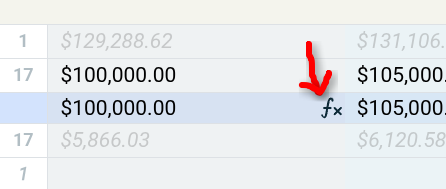
- Use the formula button beside the mouseovered cell you are in to project forward values as pictured below.
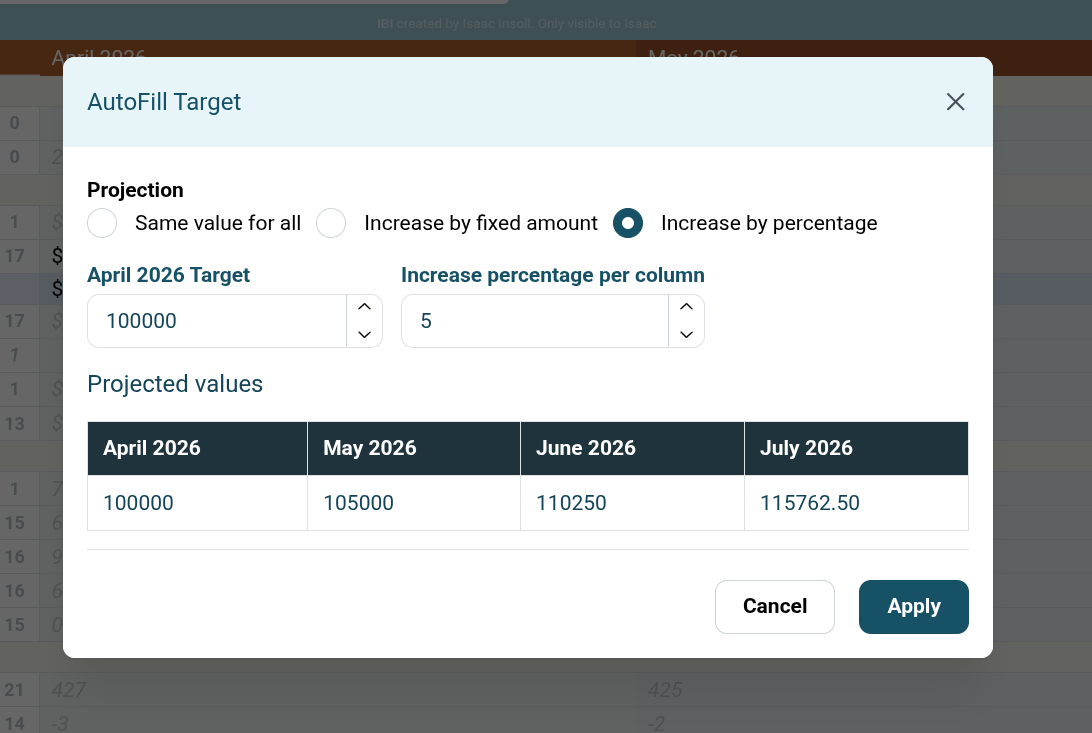
While in Edit Mode there is a bottom bar which has a Save Button, close to cancel the edits and a multi-stage undo system (ctrl+z also works)

Working with Targets
Targets in Mega Report
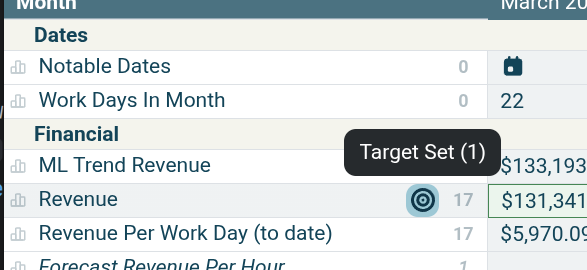
If a row in mega report has target values and you have a target view selected, you can click the target icon to see a breakdown of all Target Values for the selected row.
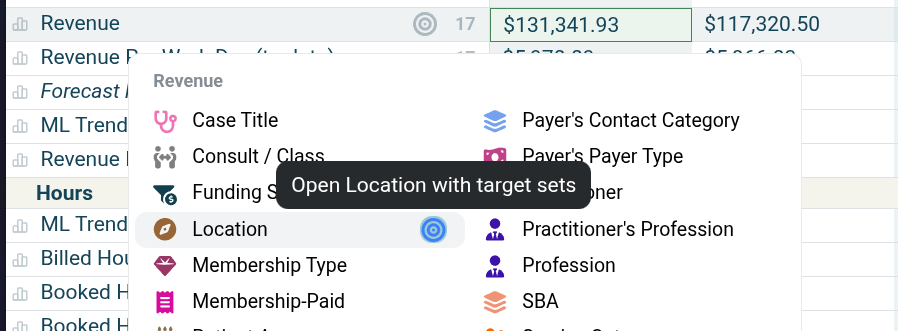
Also, if you have a breakdown (EG: 'By Location') that has target values entered then you will see a 'breakdown with targets' icon that will open the breakdown, and open the target breakdown for each of it's values.
Target Views
A Target View allows you to choose Target Sets, criteria (EG: 'greater than' or 'less than') and a color. When you turn on the Target View then cells in mega report will be color coded appropriately.
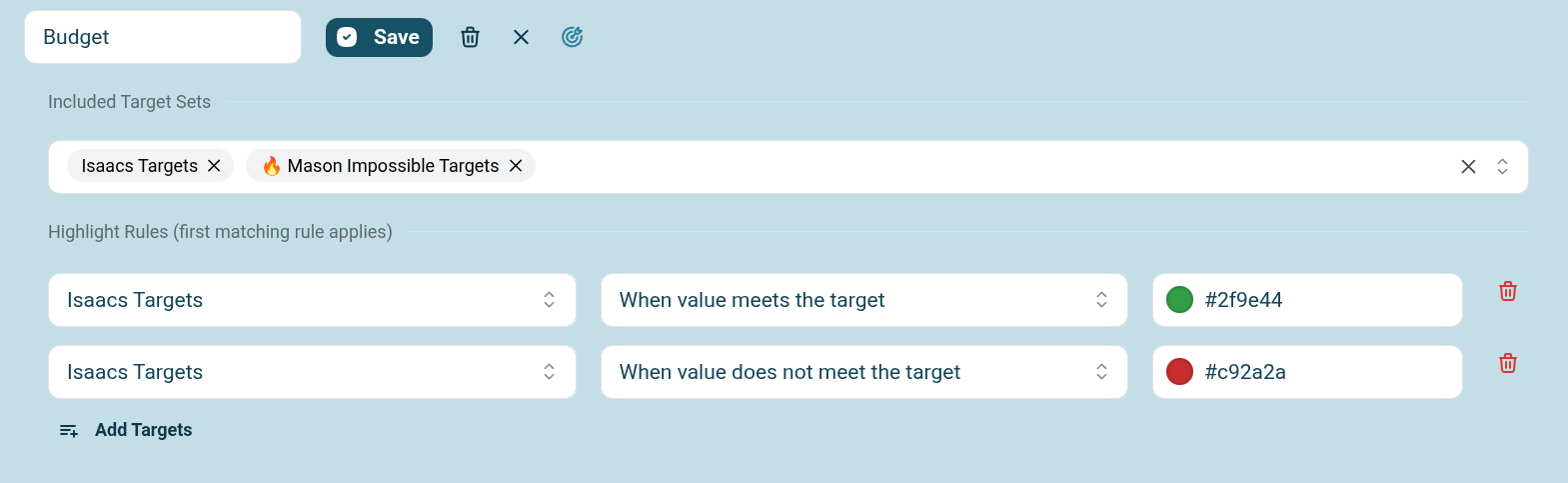

For example, you could set up a view that does:
- Color cell green if it exceeds "Isaacs Targets"
- Color cell red if it's below "Bare minimum Targets"
This way any cells that are above bare minimum but not hitting targets will be black, while anything below bare minimum would be red.
Note that the rules are processed in order and the first matching rule "wins". So with the above if the value is both above "Isaacs Targets" and below "Bare minimum Targets" then it would be green as the first rule matched. This means put the "most important" rules first.
The 'Included Target Sets' is useful when you want these target sets to appear in breakdowns, but don't necessarily want them impacting colouring of cells.
Targets on Dashboards
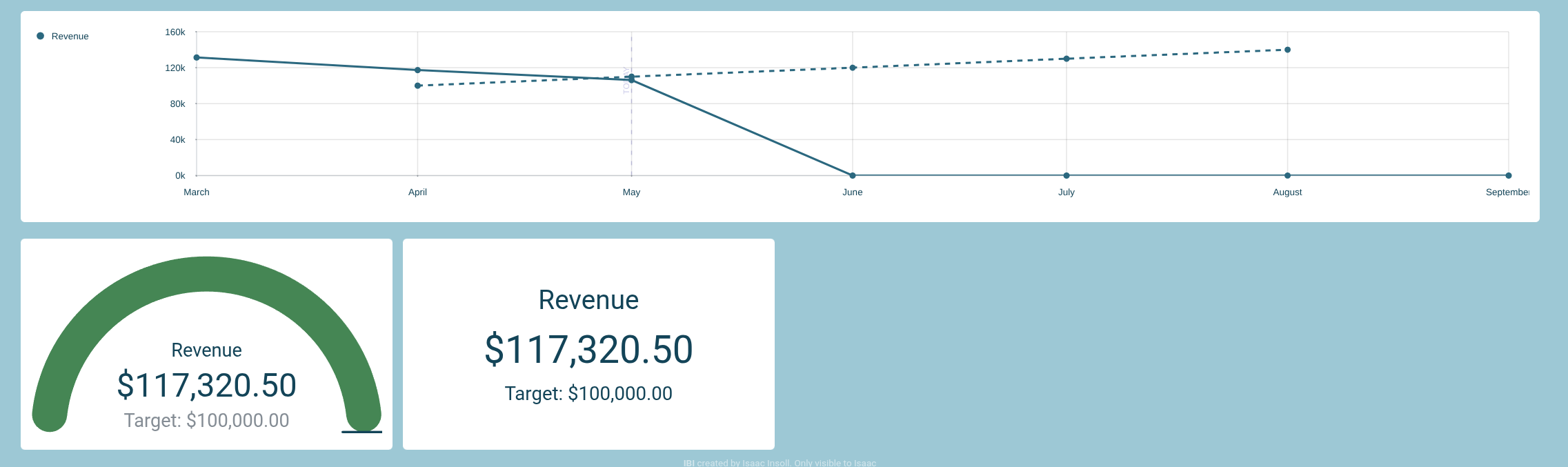
Each dashboard can have a Target Set selected while you are editing. If you choose a Target Set here then anytime you open the dashboard it will auto-select that Target Set for the dashboard. Users can choose a different Target Set while looking at any dashboard.
Each visualiser on the dashboard will present the actual data against the selected Target Set. For example the Time Series chart will show a dashed line of target values, while the gauge and number charts present the value underneath.
Rules of Targets
The concept of targets sounds incredibly simple, but when actually breaking it down it can get complicated quickly. We have a few 'rules' which we currently abide by. We are open to discussing this and changing behaviour in future.
Never Combine Targets
Example: if every location has a target we don't sum them to give you the whole company target.
Reason: If your business targets $1m a month and has 10 locations each targetting $0.1m/month, then closing one would "accidentally" reduce your company target.
Solution: Enter a target for the company of $1m, as well as per-location $0.1m
Never Split Targets.
Example: If we know the monthly target we don't automatically divide by working days if you are in weekly view
Reason: Some targets can't be divided (EG: hours per client or any ratio) and it gets complex with weekends/public holidays
Solution: Enter daily targets if you want to check daily performance. This also allows you to increase over the month if desired.
Super Nerdy: Target Value Normalisation
- Revenue by Practitioner Zac by Location GCPC
- Revenue by Location GCPC by Practitioner Zac
Internally, the filters are sorted into a stable order before saving or lookup, so both paths resolve to the same target key.
- Same logical cell means same target.
- More specific filters override broader ones where appropriate.
- Targets entered in one useful view can appear in another equivalent view.
- Users do not need to recreate the same target across multiple breakdown paths.